Best Betting Horse Racing UK — A Data-Led Buyer’s Guide for 2026
Data-driven insights for sharper racing bets
By Horse Racing Betting Analyst
 Available in US
Table of Contents
- What This Guide Answers in 90 Seconds
- Why Most “Best Bookmaker” Lists Are Selling You Short
- The State of UK Racing Betting in 2026 — Boom at the Gate, Squeeze Online
- Seven Filters That Separate a Racing Bookmaker from a Betting Site with a Racing Tab
- How I Actually Test a Racing Bookmaker — No Star Ratings, No Gut Feeling
- A Quick Tour of the Bets You Can Place on a Horse Race
- Concessions That Actually Pay You Back vs Marketing Noise
- Betting from Your Pocket — Mobile Apps and Live Streaming in 2026
- Strategic Foundations — Four Principles Before You Place a Single Bet
- Regulation, Tax and the Affordability Question — What Changed and Why You Should Care
- The Festival Calendar — Where the Best Racing Meets the Biggest Markets
- Safer Gambling — Tools That Work and Why They Matter More Than Disclaimers
- Frequently Asked Questions About Horse Racing Betting in the UK
- The Signals That Matter When Everything Else Is Noise
What This Guide Answers in 90 Seconds
- A racing bookmaker worth using offers Best Odds Guaranteed on every qualifying race, frequent Extra Places on handicaps, and genuine depth of ante-post and specials markets — welcome bonuses are one-time marketing, BOG pays you every single day.
- UK racing betting turnover has dropped 12.8% in two years, yet the Levy yield hit a record £108.9 million — fewer punters are betting, but the money reaching the sport is higher, and operators are competing harder for the customers who remain.
- Horse racing retains a 15% betting duty while Remote Gaming Duty has risen to 40% — that tax gap gives racing-focused bookmakers more headroom to fund concessions and competitive pricing.
- Cash-out margins above 10% are excessive, stream delays above three seconds make in-play betting blind, and price-shopping across two or three accounts can add 2-5% to your returns over a season.
- No brand rankings appear in this guide. The framework here is designed for you to test operators yourself — because your data is more reliable than anyone else’s opinion.
Why Most “Best Bookmaker” Lists Are Selling You Short
I spent an afternoon last spring counting the number of affiliate rankings that popped up when I searched for the best horse racing betting sites in the UK. I stopped at forty. Every one opened with a numbered list of operators, a scattering of welcome-offer badges and a vague promise that each brand had been “tested by our experts.” Not one cited a single industry statistic. Not one mentioned that total betting turnover on British racing has dropped by 12.8% in two years, or that the Levy Board still managed a record yield of £108.9 million in 2024/25 despite that decline. Two numbers that tell you everything about where money is moving in this sport — and every competitor ignored both.
That gap is why this guide exists. I have been analysing UK racing markets professionally for nine years, tracking price movements, concession quality and regulatory shifts across dozens of licensed operators. What I have built here is not another star-rated list. It is a framework: a set of data-led criteria you can apply yourself, regardless of which bookmaker catches your eye. The goal is to equip you with the same filters I use when deciding where to place my own money on a Saturday card at Newbury or an ante-post punt on the Gold Cup.
This guide covers UK-licensed operators only. Every bookmaker discussed holds a current licence from the UK Gambling Commission, the sole legal authority for regulating commercial gambling in Great Britain. If a site does not appear on the UKGC public register, it operates outside the law — full stop.
You will find no brand rankings here, no “top five” tables and no affiliate sign-up buttons. What you will find is a breakdown of what separates a genuinely competitive racing bookmaker from one that simply sponsors a few televised meetings. I will walk you through the metrics that matter — Best Odds Guaranteed policies, Extra Places frequency, cash-out margin, mobile latency, withdrawal speed — and show you how to run those checks yourself.
Whether you are placing your first each-way on the Grand National or refining a staking plan for the flat season, the framework here will sharpen your process. Let’s get into it.
The State of UK Racing Betting in 2026 — Boom at the Gate, Squeeze Online
Last June I stood in the Tattersalls enclosure at Royal Ascot and watched five million ITV viewers tune in across the week, with the final-day audience jumping by more than 20%. The stands were packed. The on-course bookmakers were shouting themselves hoarse. And yet, when I pulled up the BHA’s quarterly reports a few weeks later, the online turnover figures told the opposite story. That contrast — a thriving live product and a shrinking digital market — defines UK racing betting right now, and if you do not understand it, you will misjudge where the value sits.
£766.7m
Remote horse racing GGY, year to March 2025
5.03m
Racecourse attendance in 2025 — first time above 5 million since 2019
-12.8%
Total betting turnover decline over two years to Q3 2025
£108.9m
Record Levy Board yield in 2024/25
Remote horse racing generated £766.7 million in gross gaming yield for the financial year ending March 2025, according to the Gambling Commission’s annual industry statistics. That is a substantial share of a £16.8 billion regulated market, but the direction of travel is troubling. Total betting turnover on British racing fell 4.2% by Q3 2025 compared with the previous year, and the cumulative drop since 2023 stands at 12.8%. Core fixtures — the bread-and-butter midweek cards that keep the sport running — took the hardest hit, with average turnover per race down 14.4% in Q1 2025 alone.
Meanwhile, racecourse attendance climbed to 5.031 million in 2025, the first time the figure has topped five million since 2019, with average crowd sizes up 3.6% to 3,526 per fixture. More people are watching in person, fewer are betting online, and the Levy yield has somehow never been higher. Richard Wayman, the BHA’s Director of Racing, put it bluntly: total betting turnover has fallen by nine per cent compared with the same period in 2024, and while the racing product needs work to grow its appeal as a betting medium, a much wider range of factors is driving that decline.
The paradox matters for punters. A shrinking online pool means bookmakers are competing harder for the customers who remain. That competition shows up in more aggressive Best Odds Guaranteed terms, more frequent Extra Places on festival handicaps and better ante-post pricing. If you know where to look, a contracting market can work in your favour.
The factors Wayman alluded to are not hard to identify: affordability checks that friction the betting experience, a tax regime reshaping operator margins, and a black-market surge siphoning volume away from licensed sites. I will unpack each of those in the regulation section later, but the takeaway is straightforward. UK racing remains a £766.7 million online betting product with record Levy income and growing live audiences. The operators who survive the current squeeze will be the ones offering genuine value to racing-focused customers — and the framework in this guide will help you spot them.
Seven Filters That Separate a Racing Bookmaker from a Betting Site with a Racing Tab
A few years ago I opened accounts with eleven different UK-licensed operators over the course of a single flat season. Same races, same stakes, same discipline — backing horses I had already priced up independently. By September I had a spreadsheet that made one thing clear: three of those eleven were costing me money purely through inferior terms, not bad selections. The bookmaker you choose is a structural decision, and it compounds over hundreds of bets.
UKGC Licence — The Non-Negotiable Starting Point
Every operator you consider must hold a current licence from the UK Gambling Commission. This is not a quality badge — it is a legal requirement. A UKGC licence means the operator’s funds are segregated or insured, disputes can be escalated to an approved Alternative Dispute Resolution provider, and the site is subject to regular compliance audits. No licence, no bet — that is the baseline, not a bonus.
UKGC — The UK Gambling Commission, established under the Gambling Act 2005, is the regulatory body responsible for licensing and overseeing all commercial gambling in Great Britain.
Best Odds Guaranteed — Where the Real Edge Lives
Best Odds Guaranteed, or BOG, is a concession where the bookmaker pays you at whichever price is higher — the odds you took when you placed the bet, or the starting price at the off. If you back a horse at 10/1 in the morning and it drifts to 14/1 by post time, BOG means you get paid at 14/1. This single feature can add percentage points to your annual return, particularly if you bet early when the markets are still forming. Not every operator applies BOG to every race or stake level, so the small print matters.
Extra Places Frequency — The Each-Way Multiplier
Extra Places promotions extend the number of finishing positions that pay out on each-way bets — four places instead of three, or six instead of four on big-field handicaps. An operator that regularly offers Extra Places on competitive handicap races is giving you genuine mathematical value. I track how often each site runs these promotions across a festival week; the difference between the most generous and the stingiest is stark.
Depth of Markets — Beyond Win and Each-Way
A serious racing bookmaker prices up ante-post markets months in advance, offers betting-without-the-favourite, and covers specials such as top jockey, top trainer and match bets. If the only options available are win and each-way on the day of the race, the site is treating racing as an afterthought. Depth of market is a proxy for how seriously the operator takes the sport.
Price-Shopping Headroom — The 2-5% You Are Leaving on the Table
Independent price-comparison data consistently shows that the difference between the best and worst available odds on the same horse in the same race can run to 2-5% of the return. Over a season of regular betting, that gap compounds significantly. The practical implication: you need accounts with at least two or three operators so you can take the best price available at the time you want to bet. A single-account punter is structurally disadvantaged.
Do
- Open accounts with two or three UKGC-licensed operators to compare prices before every bet.
- Check BOG terms for each race type — some operators exclude ante-post or festival races.
- Track Extra Places promotions across a festival week to identify which sites offer them most consistently.
Don’t
- Choose a bookmaker based solely on the size of a welcome offer — a sign-up bonus is a one-time event, BOG pays you every single race.
- Assume all operators price the same markets — depth varies enormously, especially for ante-post and specials.
- Ignore withdrawal speed; a bookmaker that takes five days to process a payout is borrowing your money interest-free.

Live Streaming Availability
Being able to watch the race you have bet on matters — not just for entertainment, but for informed in-play decisions. Most major UK-licensed operators stream ITV-covered meetings and selected other cards, usually requiring a funded account or a placed bet. The quality and latency of the stream vary, and I cover that in more detail in the mobile and streaming section below.
Withdrawal Speed — The Test Nobody Talks About
I time withdrawals the way I time sectionals. A bookmaker that processes a bank transfer within 24 hours signals operational efficiency and customer respect. One that takes three to five working days is either under-resourced or deliberately slowing payouts. The difference is a reliable indicator of how the operator views its racing customers.
How I Actually Test a Racing Bookmaker — No Star Ratings, No Gut Feeling
Every January I reset my tracking spreadsheet. Not out of superstition — out of method. Over nine years, I have learned that the only way to evaluate an operator for racing is to run a structured test over a meaningful sample. Star ratings and “expert verdicts” are opinions dressed in formatting. What follows is the process I use, and it informs the criteria throughout this guide.
The Four-Check Evaluation Process
- SP vs early price comparison: record the price you take in the morning and compare it to SP across 50 races. An operator where your early prices beat SP in fewer than 55% of races is not pricing competitively for morning punters.
- Extra Places audit: track 30 competitive handicaps across a two-month period and note how many times the operator offers Extra Places. Anything below 60% of those races is below the standard set by the most committed racing bookmakers.
- Cash-out spread test: request cash-out on ten open bets and calculate the implied margin between the cash-out offer and the theoretical fair value of the remaining leg. A spread above 10% is excessive; above 15%, the feature is designed to extract value from you, not return it.
- Stream latency check: compare the operator’s live stream against a real-time data feed during five separate race meetings. A delay of more than three seconds creates a meaningful information disadvantage for in-play betting.
None of these checks require specialist tools. A notepad, a timer and a basic understanding of implied probability are enough. The point is discipline: you are gathering evidence over a sample, not reacting to a single good or bad experience. One generous Extra Places promotion on Gold Cup day does not make an operator racing-focused — consistency across ordinary midweek cards does.
I run this process on a rolling basis, updating findings every quarter. Racing bookmakers change their terms, reduce concessions, tweak pricing algorithms. A site that tested well in the spring jumps season might tighten margins by the time the flat gets going at Newmarket. Static reviews go stale; process-based evaluation does not.
If you want a single shortcut, here it is: open two or three accounts, bet the same selections across them for a month, and compare your returns. The numbers will do the talking far more honestly than any review site — including this one.
A Quick Tour of the Bets You Can Place on a Horse Race
My first ever bet on a horse was an each-way on a 25/1 shot at Wetherby. I had no idea what the place terms were, no idea how the return was calculated, and no idea that the same stake could have been deployed in half a dozen different formats. I won the place leg and felt like a genius — then spent the next two years learning exactly how much I did not know. This section is the map I wish I had been given that day.
The UK racing market supports a wider range of bet types than almost any other sport. What follows is an overview of the main formats, with enough detail to understand the mechanics and a worked example for each. For a deep dive into every variation — including place terms, dead-heat rules and the maths behind combination bets — see the full breakdown of horse racing bet types available in the UK.
Win
The simplest format: you back a horse to finish first. Your return is stake multiplied by the decimal odds, or stake multiplied by the fractional odds plus your stake back.
Example: A £10 win bet at 7/2. If the horse wins, your return is £10 x 3.5 = £35 profit, plus your £10 stake back, for a total of £45. If it finishes second or worse, you lose £10.
Each-Way
An each-way bet is two bets in one: a win bet and a place bet. The place part pays out at a fraction of the win odds — typically 1/4 or 1/5 — if the horse finishes in the designated places. The number of places depends on the field size and race type: two places for five-to-seven runners, three for eight or more, four for handicaps with sixteen or more runners.
Example: A £5 each-way bet at 10/1 on a 16-runner handicap (1/4 odds, four places). Total stake is £10. If the horse wins, you collect win profit (£50) plus place profit (£12.50), totalling £62.50 profit. If the horse finishes second through fourth, you lose the £5 win stake but collect £12.50 place profit — £7.50 net.
Accumulator
An accumulator chains multiple selections into a single bet, with the returns from each winner rolling into the next leg. The potential payouts are large, but every selection must win. The mathematical reality is that the bookmaker’s margin compounds with every leg, making long accumulators a poor long-term proposition for serious punters.
Forecast and Tricast
A straight forecast requires you to name the first and second in the correct order. A tricast extends that to first, second and third. Returns are calculated via a computer-generated dividend based on the SP of the placed horses. A reverse forecast covers both possible orderings, doubling the stake but removing the need to predict exact order.
Lucky 15 and Combination Bets
A Lucky 15 is fifteen bets across four selections: four singles, six doubles, four trebles and one four-fold. The appeal is that a single winner still returns something, and many operators offer consolation bonuses — treble odds for a sole winner, for instance. The downside is a minimum stake of fifteen units. Related formats include the Yankee (eleven bets, no singles) and Heinz (fifty-seven bets on six selections).
Win
Back a horse to finish first. Simplest format, lowest margin.
Each-Way
Two bets in one: win and place. Ideal for big-field handicaps.
Forecast / Tricast
Predict exact finishing order. High risk, high reward in large fields.
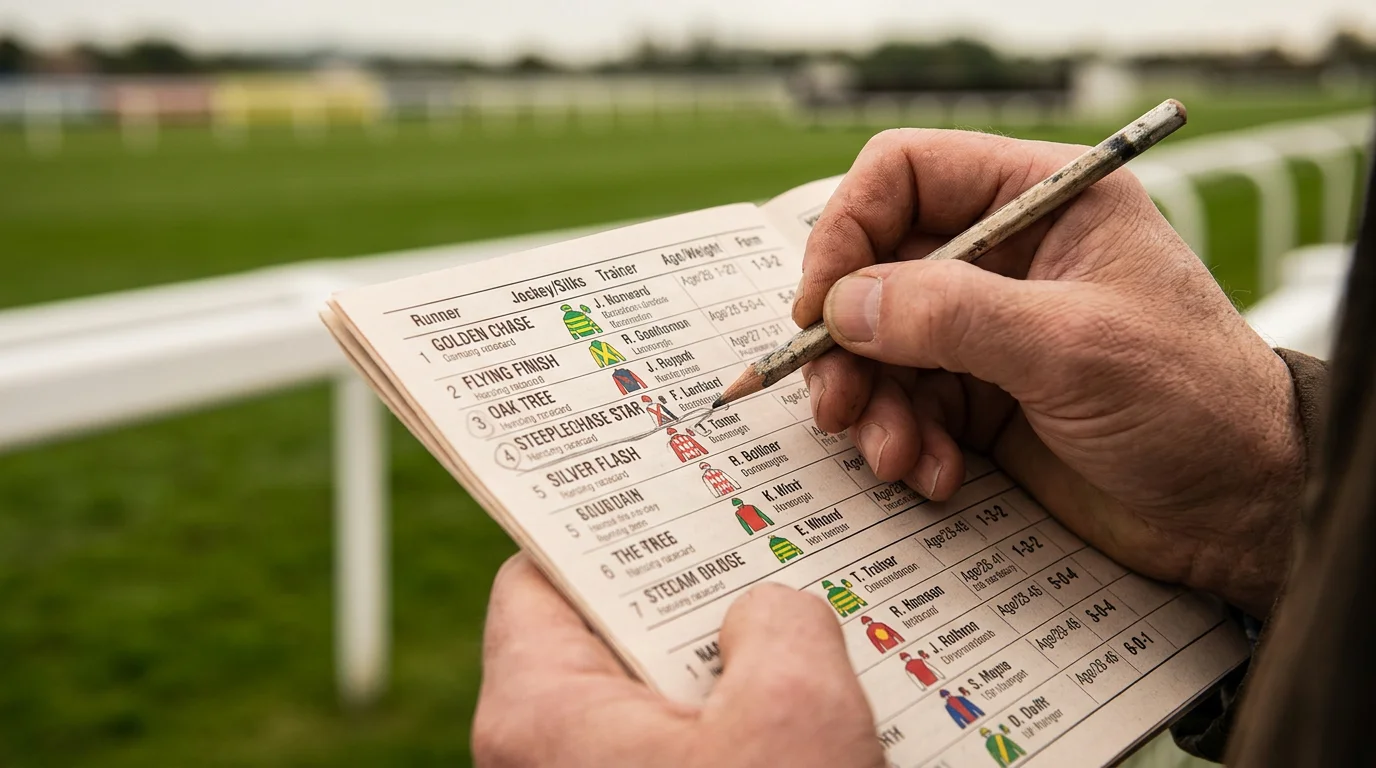
Understanding the bet types is the first step — the next is knowing which concessions and promotions can tilt the maths further in your favour.
Concessions That Actually Pay You Back vs Marketing Noise
I once calculated that a single Best Odds Guaranteed upgrade on a 12/1 winner that drifted to 16/1 was worth more to me than the entire welcome bonus I had collected when I opened the account. That was the moment I stopped paying attention to sign-up offers and started obsessing over ongoing concessions. The distinction matters enormously for anyone who bets on racing regularly, and the industry does a terrible job of explaining it.
Best Odds Guaranteed — The Concession That Keeps Giving
BOG is the single most valuable ongoing concession for a racing punter. Every time you take an early price and the SP is higher, BOG pays you the difference — automatically, on every qualifying race. Over a season of several hundred bets, those upgrades compound into a meaningful addition to your bottom line. A welcome offer is spent once. BOG works every single day you bet. For a deeper look at welcome offers and how they compare to ongoing concessions, see our guide to horse racing welcome offers in the UK.
Extra Places — Hidden Value on Handicap Days
Extra Places promotions extend the each-way place terms beyond the standard positions — paying four places instead of three, or six instead of four, on selected races. The value is real and quantifiable: an additional place position on a 20-runner handicap at 1/4 odds reduces the bookmaker’s edge on the place portion of your bet. Festival weeks and ITV-broadcast Saturdays are when these promotions appear most frequently, but some operators run them on midweek cards too. Track which ones do — it is one of the clearest signals of a racing-focused operator.
Non-Runner No Bet
NRNB guarantees a full refund if your ante-post selection is withdrawn before the race. Without it, an ante-post bet on a horse that does not make the final declarations is a dead loss. This concession is especially relevant during the National Hunt season, when injury withdrawals from Cheltenham and Aintree markets are common.
Money-Back Specials and ITV 7
Money-back specials — refunds if your horse finishes second to the favourite, or loses by a short head, for example — appear regularly around big meetings. They are nice to have but marginal in expected-value terms. The ITV 7 is a free-to-play competition that rewards correctly predicting the winners of seven ITV-broadcast races, often with a cash prize pool. It costs nothing to enter and gives you a reason to watch races you might otherwise skip.
The tax environment has reshaped how operators fund concessions. With Remote Gaming Duty rising to 40% from April 2026 and online betting duties climbing to 25% from 2027, operators are under pressure to trim margins. Horse racing, however, retained its 15% duty rate — a regulatory carve-out that gives racing-focused bookmakers more headroom to maintain BOG and Extra Places. That exemption is not guaranteed to last, so take advantage while it holds.
The hierarchy is clear: BOG first, Extra Places second, NRNB third, everything else is decoration. If an operator offers all three consistently across the racing calendar, they are serious about the sport. If they lead with a flashy welcome offer but quietly exclude racing from their BOG terms, look elsewhere.
Betting from Your Pocket — Mobile Apps and Live Streaming in 2026
During Cheltenham Festival 2024, more than 80% of all bets placed were made through mobile devices. That number did not surprise me — I had watched the shift happen in real time over the previous five years, standing in betting rings where punters checked three different apps before placing a single each-way. The smartphone is now the primary betting terminal for UK racing, and how well an operator’s app handles that responsibility is a genuine differentiator.
80%+
Cheltenham bets placed via mobile in 2024
<3s
Acceptable stream delay for in-play racing
ITV + RUK + Sky
Main streaming sources available through apps
A racing-focused app needs to do three things well. First, it must load racecards quickly and display form data readably — runner silks, recent results, trainer and jockey statistics, going preferences. Second, the bet slip must handle complex bet types without friction: each-way toggles, forecast combinations, Lucky 15 builds. Third, the app must push notifications for non-runner updates, market movements and result confirmations. Missing a late withdrawal because the app did not alert you is a preventable loss.
Live streaming through betting apps typically requires either a funded account or a bet placed on the relevant meeting. Coverage usually includes all UK and Irish races broadcast on ITV, Racing TV and At The Races, though the exact schedule varies by operator and by day. Streaming is geo-restricted to the UK and Ireland on most platforms.
Stream latency is the hidden variable. A delay of more than three seconds between the live action and your screen means the in-play market has already moved by the time you see a horse challenge for the lead. I test this by comparing app streams against real-time data feeds, and the variation between operators is wider than most punters realise. The best apps deliver streams within one to two seconds of real time; the worst lag by five or six seconds, which makes in-running betting essentially blind. For a detailed comparison of app features, streaming quality and mobile-specific concessions, see our full guide to horse racing betting apps in the UK.
One final point: the app stores themselves apply quality controls. Both Apple and Google require gambling apps to carry age verification and responsible gambling tools. If an operator’s app is not available on your platform’s official store, treat that as a red flag about the operator’s broader standards.
Strategic Foundations — Four Principles Before You Place a Single Bet
The worst losing run I ever had lasted twenty-two bets. Not because my selections were terrible — retrospectively, four of them were genuine value — but because I had no staking plan, no bankroll limit and no system for recording what I was doing. I was guessing the stakes, chasing the losses, and rewriting my memory of bad decisions to feel better about the next one. It took three months of disciplined record-keeping to undo those habits. If there is one section where I am speaking from scar tissue, it is this one.
Bankroll Management — The Fence Around Your Money
Your bankroll is the total amount of money you have set aside for betting — separate from rent, bills, savings, everything. It is not what you can “afford to lose” this week; it is a defined, fixed sum that you treat as a working capital pool. I recommend starting with a bankroll you could lose entirely without it affecting your daily life, then dividing it into units of 1-2% each. A £500 bankroll means individual stakes of £5-£10. That discipline sounds boring. It is also what separates people who bet for years from people who blow through a month’s wages on a bad Saturday at Newmarket.
Value Identification — Price vs Probability
A horse priced at 4/1 implies a 20% chance of winning. If your analysis suggests the actual probability is closer to 28%, that is a value bet — the price is higher than the risk justifies. You do not need to be right every time; you need to be right about the probability more often than the market is. Every serious racing punter I know thinks in terms of probability rather than price.
Example: Suppose you assess a horse’s winning chance at 28%. The fair odds would be approximately 5/2 (100/28 = 3.57, minus 1 = 2.57). If the bookmaker offers 4/1 (implied probability 20%), the overlay is 8 percentage points — a significant edge. If, however, the bookmaker offers 2/1 (implied probability 33%), you are taking the worst of it, even if the horse wins.
Staking Plans — Level Stakes or Proportional
Level staking means betting the same amount on every selection, regardless of price or confidence. Proportional staking adjusts the size of each bet according to the perceived edge. Both approaches have merits: level staking protects you from overconfidence, proportional staking rewards strong analysis. For anyone starting out, level stakes is the right choice. Leave the more sophisticated models until you have a verifiable track record of identifying value. Our guide to horse racing betting strategies covers each approach in detail.
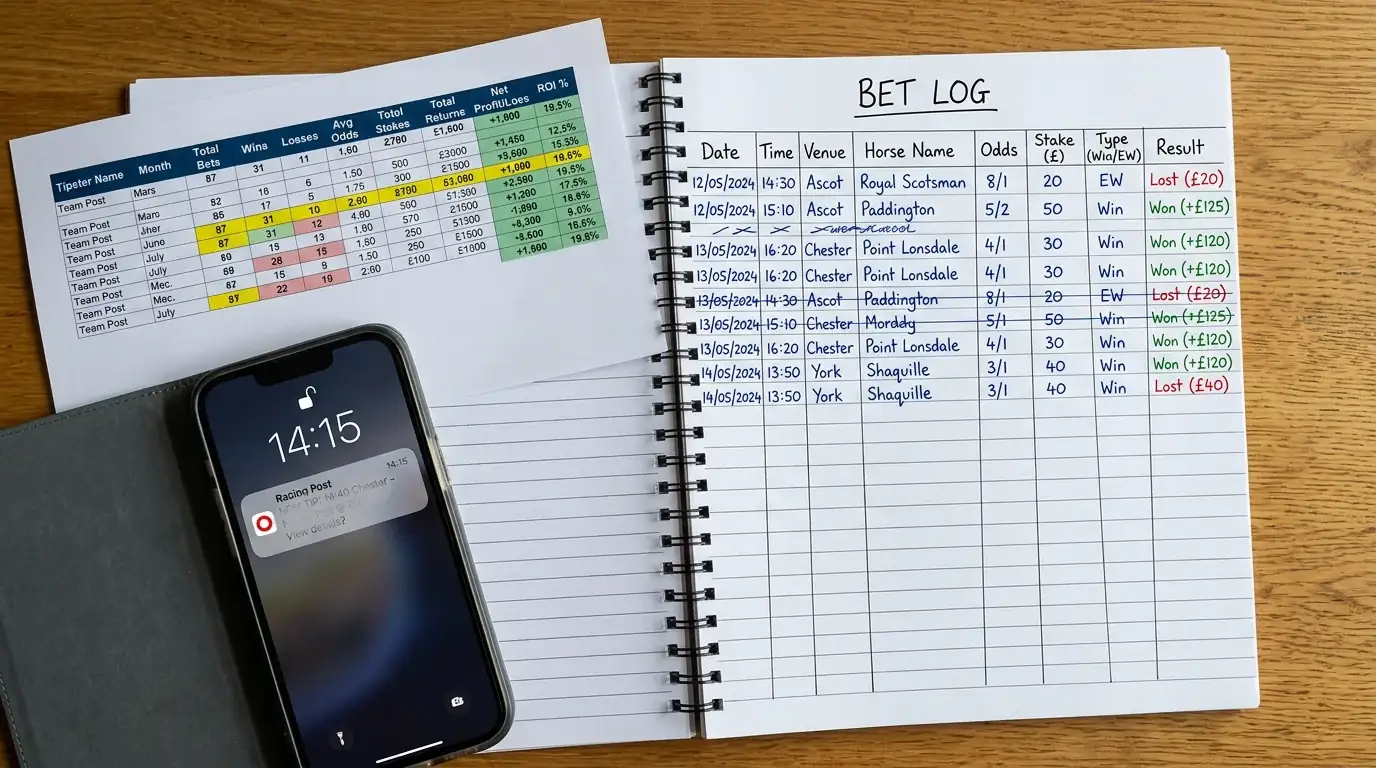
The single most important habit in racing betting is keeping records. Every bet: date, race, selection, odds taken, stake, result, return. Without this data, you cannot calculate your strike rate, your ROI, your average winning price or your drawdown. You are flying blind, and no strategy survives contact with blind flying.
Do
- Set a fixed bankroll before the season starts and divide it into 1-2% units.
- Record every bet — selection, odds, stake, result — in a simple spreadsheet.
- Think in probabilities, not prices: ask “is this horse more likely to win than the odds imply?” before every bet.
Don’t
- Chase losses by increasing stakes after a losing run — this is the fastest route to busting a bankroll.
- Confuse short-term results with long-term edge: a profitable month does not validate a bad process, and a losing month does not invalidate a good one.
- Skip the record-keeping — memory is unreliable and biased towards your best wins, not your overall performance.

Strategy in racing betting is not about finding a secret system. It is about stacking small, evidence-based advantages — accurate probability assessment, disciplined staking, competitive pricing — into a process that holds up over hundreds of bets.
Regulation, Tax and the Affordability Question — What Changed and Why You Should Care
In October 2025, Rachel Reeves stood at the despatch box and announced one of the most consequential tax changes the UK gambling industry has ever faced. Remote Gaming Duty would jump from 21% to 40%, effective April 2026. Online betting duty — excluding horse racing — would rise from 15% to 25% from April 2027. The Chancellor was explicit: remote gaming is associated with the highest levels of harm, and she was increasing the duty accordingly. She made no change to the taxes on in-person gambling or on horse racing. That final sentence, delivered almost as an aside, reshaped the competitive landscape for every racing bookmaker in Britain.
Grainne Hurst, Chief Executive of the Betting and Gaming Council, called the increases a devastating hammer blow to tens of thousands of people working in the industry and to millions of customers who enjoy a bet. The House of Commons Library estimated the reforms would generate £810 million in additional revenue in 2026/27, rising to £1.16 billion by 2030/31. That money comes from a combination of reduced operator margins, fewer promotions and — in some cases — tighter restrictions on what customers can win.
Horse racing’s exemption from the online betting duty increase is not generosity — it is strategic. The Levy mechanism, which channels a percentage of racing betting revenue into the sport’s prize funds and infrastructure, depends on a sustainable betting market. Raising the duty on racing bets would directly shrink the Levy pot and, with it, the sport’s ability to fund itself. The Treasury understood that breaking racing would cost more than taxing it.
The second regulatory pressure point is affordability checks. The Gambling Commission has been piloting a framework that requires operators to verify customers’ financial circumstances when their losses exceed certain thresholds. The data from the Racing Post’s Big Punting Survey tells the story: the share of respondents who had been subjected to affordability checks rose from 16.6% in 2023 to 23.7% in 2025. The BHA estimates that operators could lose £900 million in annual revenue if the checks are implemented at the proposed thresholds, with the racing industry itself facing £250 million in losses over five years.
These checks are not abstract bureaucracy. They mean being asked to provide bank statements, payslips or proof of income before you can continue betting at a level you have maintained for years. The friction is real, and it is driving behaviour change — Hurst has argued that forcing punters to hand over bank statements will push customers to the illegal market, where there are no safeguards at all.
The evidence supports that fear. The International Federation of Horseracing Authorities found that unique visitors to 22 unlicensed betting sites offering markets on British racing grew by 522% between August 2021 and September 2024. The regulated sector supports 109,000 jobs and contributes £4 billion in annual tax revenue. Every customer who moves to an unlicensed offshore site is lost to taxation, to Levy funding and to the safer-gambling protections that the regulations were designed to provide.
For punters, the regulatory picture in 2026 comes down to this: horse racing retains a more favourable tax position than any other form of online gambling in the UK, giving racing-focused bookmakers more room for competitive pricing. Affordability checks are expanding and the black market is growing. Choosing a UKGC-licensed operator is not just a legal requirement — it is an active defence of the funding model that keeps the sport alive.
The Festival Calendar — Where the Best Racing Meets the Biggest Markets
There is a particular energy on the morning of the first race at Cheltenham that I have never found anywhere else in sport. The roar when the tape goes up on the Supreme Novices’ Hurdle is the sound of a year’s worth of ante-post bets, tipster arguments and pub debates reaching their conclusion in three minutes of Cotswold hillside. Festivals are where racing betting reaches its peak, and understanding the calendar is essential for any punter who wants to plan rather than react.
Cheltenham Festival
Four days in March, 28 races, the single biggest betting event in the National Hunt calendar. Cheltenham is where the ante-post market is deepest, Extra Places promotions are most generous and the pricing competition between bookmakers is fiercest. The meeting draws enormous liquidity, which means tighter margins and better value for punters who shop early. The Gold Cup, Champion Hurdle and Stayers’ Hurdle are the headline events, but the big-field handicaps — the Coral Cup, the County Hurdle, the Martin Pipe — are where each-way punters find the real opportunities.
Grand National
The Grand National at Aintree is the most bet-upon horse race in Britain. The field of up to 40 runners over four miles and two-and-a-half furlongs makes it a unique test, and the each-way terms reflect the spectacle: typically six or seven places at 1/4 odds, with some operators extending to eight or ten positions. The volume of casual money in the market can create pricing inefficiencies that sharper punters exploit.
Royal Ascot
Five days of flat racing in June, watched by five million ITV viewers in 2025 — with the final-day audience growing by over 20%. Royal Ascot blends the highest quality of flat racing with the deepest betting markets of the summer season. The Royal Hunt Cup and the Wokingham Stakes are the handicapping puzzles that each-way punters anticipate all year. Ante-post markets open months in advance, and the early pricing on Group 1 races can offer genuine value before the money floods in during the week itself.
The Grand National has been run since 1839 and regularly attracts a television audience of over eight million. The each-way terms on a 40-runner field — up to ten places at some bookmakers — make it unlike any other race on the calendar for punting purposes.
Epsom Derby, Goodwood and St Leger
The Epsom Derby in June is the most prestigious classic, a mile-and-a-half test for three-year-olds that shapes the flat season’s narrative. Glorious Goodwood in late July is five days of competitive flat racing on a unique downhill track, with the Stewards’ Cup as its marquee betting heat. The St Leger at Doncaster in September is the oldest classic, and its late-season timing means ante-post markets have had months to settle — or collapse when a fancied runner is rerouted to the Arc.
Cheltenham
March. NH. 28 races. Deepest ante-post market.
Grand National
April. NH. 40 runners. Widest each-way terms.
Royal Ascot
June. Flat. 5 days. Peak summer liquidity.

For a detailed breakdown of ante-post strategies, Extra Places availability and ITV 7 opportunities across these festivals, see our guide to betting on Cheltenham, the Grand National and UK festival racing.
Safer Gambling — Tools That Work and Why They Matter More Than Disclaimers
I know experienced punters who set deposit limits on every account they hold. Not because they have a problem — because they are serious about process, and a hard limit removes the temptation to override a bad decision at midnight after a losing Saturday. Responsible gambling is not a section I am writing because the regulator requires it. It is here because every principle in this guide — bankroll management, value identification, disciplined staking — only works if you can walk away when the numbers say you should.
Every UKGC-licensed operator is legally required to offer deposit limits, loss limits, session time limits and cooling-off periods. These tools are available in the account settings of every regulated app and website. Use them. Setting a weekly deposit limit takes thirty seconds and eliminates an entire category of risk.
Beyond operator-level controls, the UK has independent support services for people who feel their gambling is becoming harmful. GamCare operates a free helpline and live chat offering confidential advice. GambleAware provides a national treatment service and educational resources. GAMSTOP allows you to self-exclude from all UKGC-licensed gambling sites for six months, one year or five years — a single registration that applies across every regulated operator in Britain.
Do
- Set a deposit limit on every betting account before you place your first bet.
- Review your betting records monthly — the numbers will tell you whether you are in control before your feelings do.
- Talk to someone if betting stops feeling like a choice and starts feeling like a compulsion — GamCare’s helpline is free, confidential and staffed by trained counsellors.
Don’t
- Bet with money allocated for rent, bills or essential expenses — your bankroll is discretionary funds only.
- Increase stakes to recover losses — this is the single most common path from recreational betting to problem gambling.
- Dismiss the tools as being “for other people” — the best punters I know use deposit limits as a discipline tool, not a safety net.
Being a sharp punter and being a responsible punter are not competing goals. They are the same goal, expressed differently.
Frequently Asked Questions About Horse Racing Betting in the UK
What is Best Odds Guaranteed and which UK bookmakers offer it for horse racing?
Best Odds Guaranteed is a concession where the bookmaker pays you at whichever price is higher — the odds you took when you placed the bet, or the starting price at the off. Most major UKGC-licensed operators offer BOG on UK and Irish racing, though terms vary: some apply it only to race-day bets, some cap the eligible stake or payout. Always check the specific conditions before relying on it.
What types of bets can I place on horse racing in the UK?
The main formats are win, each-way, accumulators, forecasts and tricasts, combination bets (Lucky 15, Yankee, Trixie) and Tote pool bets. Each has different risk-reward characteristics depending on the race, the field size and your staking approach.
How do I choose the best horse racing betting site for my style of play?
Start with a current UKGC licence and a Best Odds Guaranteed policy. Then match the operator to your betting style: frequent Extra Places for handicap punters, deep ante-post markets and NRNB for festival bettors, low-latency streaming for in-play. The most reliable test is practical — run the same selections through multiple accounts for a month and let the returns speak for themselves.
Is horse racing betting legal and how is it regulated in the UK?
Fully legal and regulated by the UK Gambling Commission under the Gambling Act 2005. Every operator serving UK customers must hold a UKGC licence. The Horserace Betting Levy Board collects a percentage of racing betting revenue to fund prize money, integrity and welfare programmes. Horse racing retains a 15% betting duty rate in 2026, lower than the duties applied to other forms of online gambling.
What are Extra Places and how do they change each-way value?
Extra Places promotions extend the number of finishing positions that pay out on each-way bets — four places instead of three, or six instead of four on big-field handicaps. Each additional paying position reduces the bookmaker’s edge on the place portion of your bet, increasing expected value on competitive handicaps. These promotions appear most often around festivals and ITV-broadcast Saturdays.
Can I watch UK horse racing live for free through betting apps?
Most UKGC-licensed apps stream UK and Irish racing, typically requiring a funded account or a bet on the relevant meeting. Coverage includes ITV, Racing TV and At The Races broadcasts. Stream quality varies between operators — the best deliver video within one to two seconds of real time, while others lag by five or more seconds. Streaming is generally geo-restricted to the UK and Ireland.
The Signals That Matter When Everything Else Is Noise
Nine years of tracking odds, testing operators and watching this market shift has taught me one thing above all: the best horse racing betting experience in the UK is not found through a ranking table. It is assembled, piece by piece, through a process.
The signals I trust have not changed much: a current UKGC licence, a consistent Best Odds Guaranteed policy, genuine depth of racing markets, competitive pricing verified against SP, and an app that streams races without meaningful delay. Those five filters eliminate the majority of operators before you ever look at a welcome offer.
The market is at an inflection point. Turnover is falling, the tax burden is rising on everything except racing, the black market is expanding and affordability checks are reshaping the landscape. But the Levy yield is at a record high, racecourse attendance has broken five million, and prize money is climbing. The sport is restructuring — and within that restructuring, there are better opportunities for punters who understand the landscape than there have been in years.
Use the framework in this guide. Open two or three accounts. Test them against each other. Track your results. Let the data tell you what works.
Created by the ”Best Betting Horse Racing” editorial team.